And the numbers don’t look good.
Scientists finally know exactly why sea levels are rising as fast as they are. It was a mystery for years—a frustrating gap in the data that kept climate models feeling a bit like guesswork. Now the ledger balances. We know where the water is coming from. And it is not just one thing.
It is everything.
The Speed Run
Global sea levels are moving twice as fast now compared to the 1960s.
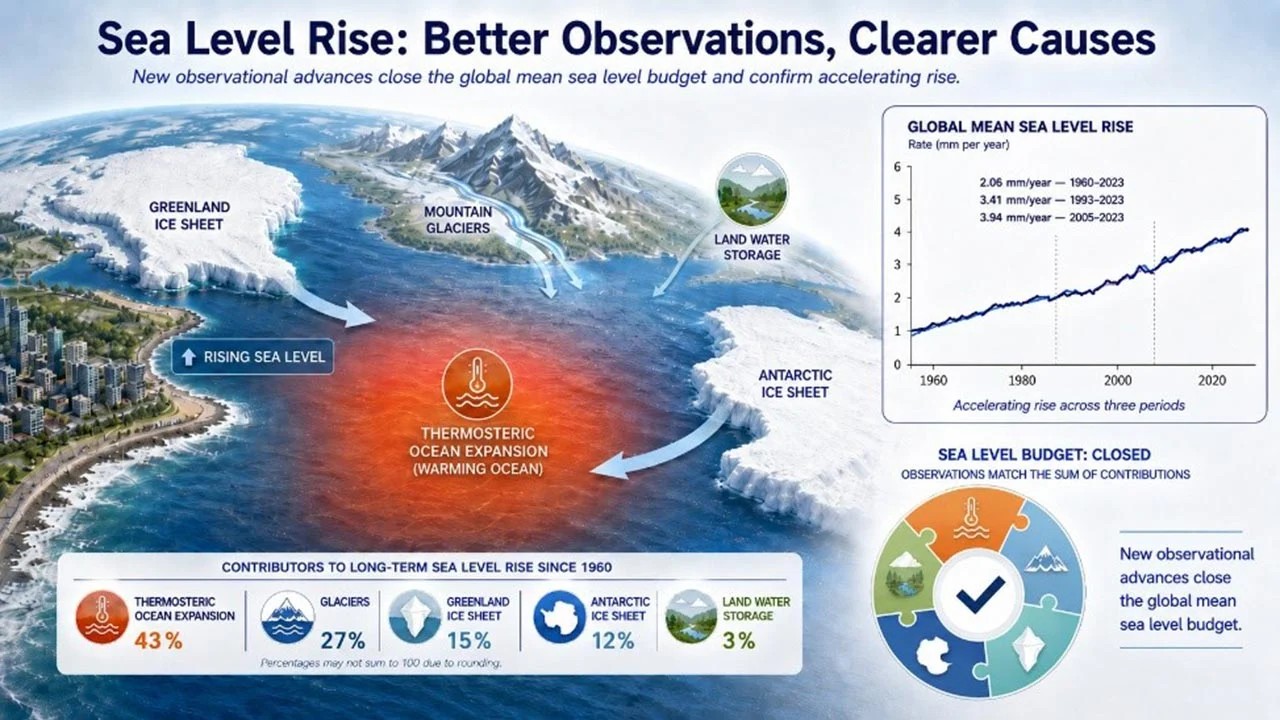
Back then it was a crawl. 2.06 millimeters a year. Since 2005 the pace has nearly doubled. We are seeing 3.94 millometers per year. That does not sound like much. A few grains of rice stacked every twelve months.
But over a continent? That is meters of change. That is infrastructure gone. That is homes underwater.
The primary culprit is heat. Simple thermodynamics. Warm water expands. Cold water shrinks. As the ocean absorbs heat trapped by our emissions it takes up more space. This physical expansion alone accounts for 43 percent of the total rise since 1960 It is the heavyweight champion of this crisis.
Ice is close behind. Mountain glaciers contribute 27 percent. Greenland adds 15 percent. Antarctica adds 12 percent. The remaining 3 percent comes from land water storage shifting. Rain in a different place. Lakes drying up.
Earlier on, heat did most of the work. Now the ice is doing more of it.
For the first half of this dataset, warming oceans and changes in land storage drove the needle. But since the 19900s the narrative shifted. Glaciers and ice sheets started losing mass faster than before. The driver changed from thermal expansion to sheer volume added to the system.
Closing The Gap
Here is why this matters beyond the grim statistics. For decades, climate scientists had a nagging inconsistency. They could measure how much the sea rose. They could estimate how much rose from known causes like heat and melt.
The numbers didn’t match. There was missing water. Unaccounted-for rise.
It made the science look fuzzy. Critics pounced on the gaps. Researchers shrugged and said we are trying.
This new study, published in Science Advances, plugged the hole. The international team—including folks from China, the US, and France—didn’t just throw more data at the problem. They fixed the instruments. They corrected satellite observations that had drifted since 2015. They improved how they measure land moving up or down near coastal gauges.
“We can explain sea level rise with greater confidentiality,” says John Abraham of the University of St Thomas.
Wait, let me check the quote. It was confidence. Yes. We can predict the rise with far more certainty now. The mystery is solved. The gap is closed.
This isn’t just academic victory lap stuff. It means when models say 2 meters of rise by 2100 you can believe it when they say it will continue long after that.
No Off Switch
There is no stopping this momentum any time soon.
Even if we cut every greenhouse gas emission today right at this very second the oceans will keep rising. For centuries.
Why? Inertia. Massive thermal inertia.
The deep ocean holds onto heat like a bear hugs a beehive. It warms slowly. It cools slowly. And while it stays warm the water keeps expanding.
Meanwhile glaciers and ice sheets are geological behemoths. They don’t respond to weekly news cycles or monthly emission reports. They respond to decades. The melt has been baking in since the 20th century started accelerating. It will outlive our grandchildren. And likely their children’s children too.
So here we are. The measurement problem is fixed. We know precisely what is sinking us. Heat. Ice. Time.
Nothing changes unless the variables do. But the variables are set. The heat is already there. The ice is already cracking.
What are we going to build on this land while it slowly disappears beneath our feet?