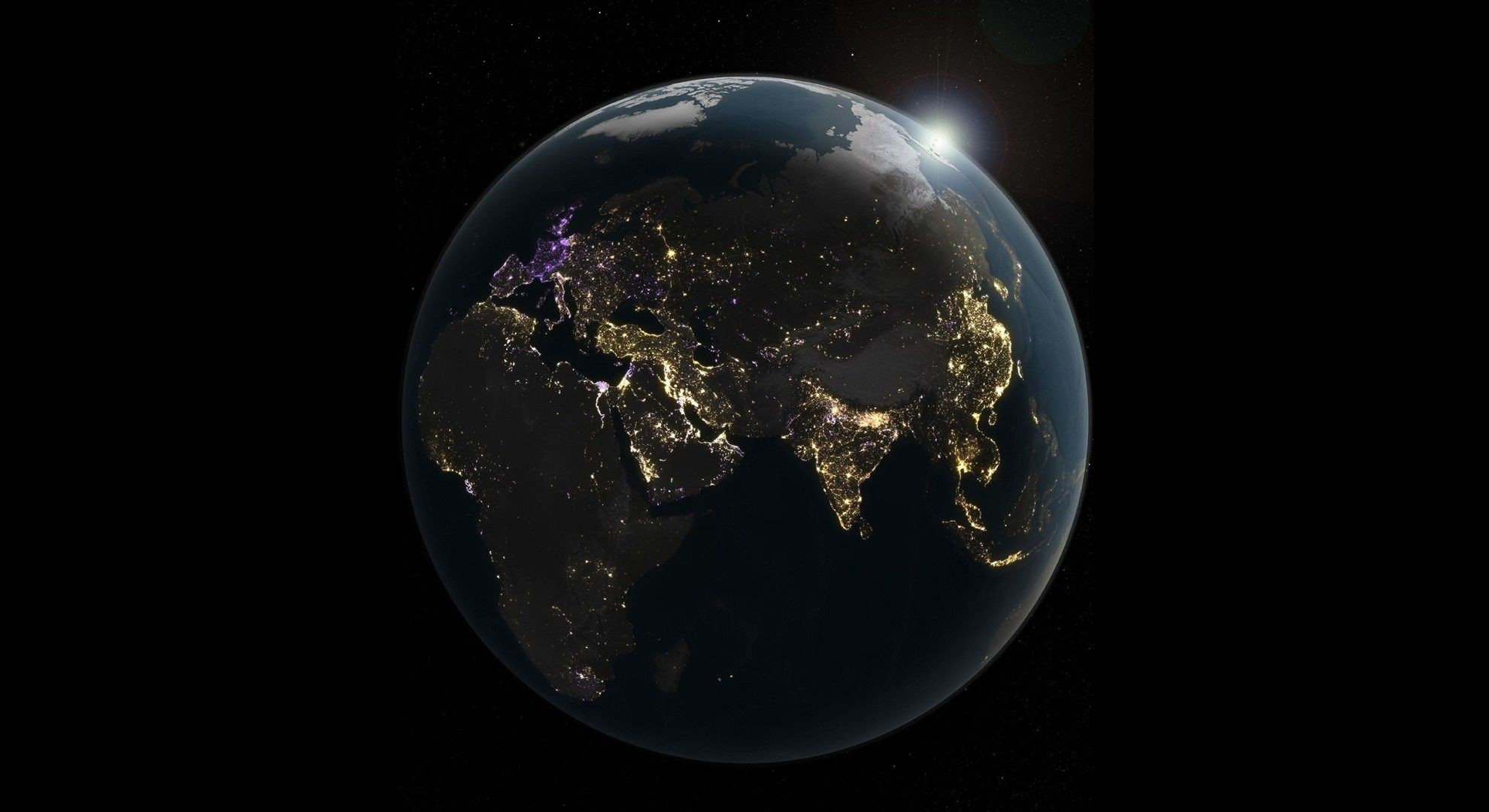
NASA looked down. What they saw wasn’t just a brightening world.
It’s messy. Complicated. And frankly, kind of surprising.
A fresh analysis from the Black Marble project — nine years of data, no less — shows Earth getting brighter overall, sure, but only in places. Elsewhere, things are getting darker. Much darker.
Here’s the twist: global nighttime radiance went up 34% between 2012 and 2020. Big jump, right? Yes. But that average hides a chaotic reality. The VIIRS instruments on board several satellites (Suomi-NPP, NOAA-20, NOAA-21) tracked these shifts. Instead of a steady glow-out across the board, the data shows “bidirectional changes.” One country turns on the lights, its neighbor turns them off. Sometimes literally at the same time.
Why?
Well. It depends.
## The U.S. Split
Take the United States. A perfect study in contradiction.
West Coast cities? Blazing bright. Populations are growing, concrete is pouring, LEDs are being installed at a furious rate. You’d think the rest of the country would follow.
You’d be wrong.
Much of the East Coast actually got darker. NASA attributes this to two things. First, energy-efficient LEDs. They need less power to make the same light, and some of the older, wastier bulbs are just going away. Second? Economic restructuring. The rust belt didn’t exactly get a lighting upgrade during that stretch.
Europe didn’t join the brightening party either. In fact, they pulled back. Conservation policies, anti-light-pollution efforts, and general energy savings drove down the lumen count. France specifically deserves a nod here, leading aggressive “dark-sky” initiatives that actually cut visible light output from orbit.
## War, Money, and Light
Lights tell a story when policies don’t. Or when things go bad.
Look at the dark patches. They’re not random. In Ukraine, Lebanon, Yemen, Afghanistan, and Venezuela, the night got significantly dimmer. The causes? War. Infrastructure collapse. Economic implosion. You turn off the lights when you’re fighting or can’t pay the bill. The satellite sees exactly that.
Flip it to Sub-Saharan Africa and Southeast Asia. Here, the lights are booming. Electrification is finally hitting previously black zones. Industrial growth, urbanization, infrastructure projects. China and Northern India lead this charge. The strongest increases on the entire planet.
So who is winning the light war? Not everyone. Nowhere.
## More Than Just Pretty Maps
You might think NASA is just making pretty pictures for the coffee table. It’s not.
The Black Marble product does heavy lifting. It strips out the noise. Moonlight. Clouds. Snow. Atmospheric haze. All gone. What’s left is human-made light, detected across wavelengths from green to near-infrared.
Old satellite maps? Clunky composites taken years apart. Blurry history.
This data is daily. Dynamic. It catches power outages the minute they happen. It tracks disaster recovery. It watches industrial zones hum or die. It even tracks fishing fleets hauling their lights through the Pacific.
But there’s a cost to this visibility. Or rather, the visibility is the problem.
“Nighttime-light measurements… offers insight into the spread of light pollution.”
Astronomers hate it. Ecologists worry. So do doctors.
Artificial light isn’t just an eyesore. It disrupts ecosystems. Migrating birds get confused. Insects spin out of control. Sea turtles lose their way. For us? It messes with circadian rhythms. Keeps us awake. Keeps the stars hidden.
We are changing the night. Just not uniformly.
Economics dictate where we shine. Technology changes how we shine. Conflict turns the switches off. The planet doesn’t glow evenly anymore. It flickers.
It’s a shifting portrait. Visible from space. Hard to ignore from below.