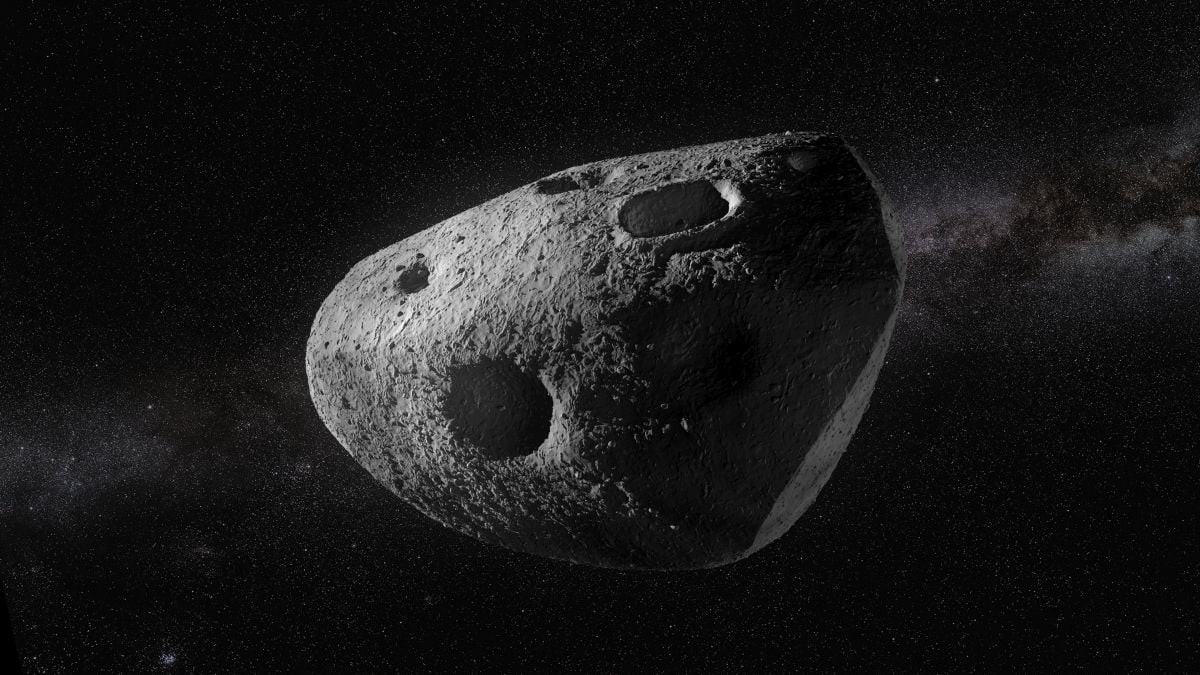
April 2029 isn’t just another date on the calendar. It’s a once-in-a-generation window.
Asteroid 99942 Apophis is coming home.
This 370-meter-wide chunk of space rock will pass within 31,900 kilometers (19,900 miles) of Earth. Closer than the moon. Close enough to see with the naked eye from dark skies. Close enough to change everything we think we know about how these ancient visitors behave under extreme gravity.
The public narrative is simple: Apophis is a threat that isn’t one. Scientists have tracked it for decades. The math is solid. It will miss us. Hard.
But here is the wrinkle nobody is talking about.
Earth isn’t the only thing Apophis has to worry about. Or rather, we are the problem.
New research suggests that our own garbage—thousands of tons of defunct satellites and bolted-on metal scraps orbiting in geosynchronous orbit (GEO)—could interfere with the most important scientific observation in decades.
The “Null Experiment” That Wasn’t
Physicist Giulia Schettino and astrodynamicist Alessandro Rossifrom the Institute of Applied Physics “Nello Carrara” (IFAC) of the Italian National Council (CNR) set out to answer a straightforward question.
Could Apophis hit space junk during its flyby?
Rossi, an expert in both space debris and asteroid dynamics, admits he was surprised.
“I have to say that I was expecting a ‘null experiment’,” Rossi told ScienceAlert. “I was struck by the possibility to have objects potentially coming to less than a few km from the asteroid.”
Most people assume space junk is a problem only in low-Earth orbit (LEO). That’s where the International Space Station lives. That’s where debris collides and creates clouds of shrapnel.
But GEO is different. It sits much higher—about 36,000 km up. Fewer satellites. Less clutter. Or so we thought.
The researchers modeled Apophis’s precise trajectory through GEO. They accounted for known objects. Then, they added the “unseen”—the small fragments, the paint flecks, the dead satellites that orbit trackers can’t resolve.
The result? A small, but statistically real, chance of a glancing blow.
Not a collision. Not a DART-style impact. Something subtler.
Why a Glancing Blow Matters (More Than You Think)
Let’s be clear. Apophis is not going to be knocked off course.
If a piece of debris, even something the size of a toaster, clips the asteroid, its orbit will remain unchanged. The gravitational tug of Earth dominates so completely that a minor bump doesn’t matter for trajectory calculations.
But science isn’t just about where the rock ends up. It’s about how it gets there.
The Science Goal
NASA’s OSIRIS-APEX mission and the ESA’s RAMSES mission are positioning themselves for a front-row seat. They want to watch Earth’s gravity tear into Apophis.
They expect:
- Changes in the asteroid’s spin.
- “Asteroid quakes.”
- Landslides on the surface.
- Exposure of pristine, hidden subsurface material.
These events are rare. We rarely get this close to a near-Earth object during a chaotic gravitational interaction.
If something hits Apophis before it reaches its closest point to Earth, it complicates the data.
“If you have a signal from an impact, how do you know if a landslide was caused by tidal forces or by the impact itself?” Schettino reasoned.
It muddies the water. It turns a clear signal into noise.
The Bigger Picture: A Blind Spot in High Orbit
The study highlights a disturbing blind spot.
We track large satellites. We know where the active ones are. We have good maps for GEO.
What we don’t know are the small pieces. The fragments too faint for telescopes. The debris from old explosions.
Rossi points out that this lack of visibility is a risk not just for Apophis, but for the infrastructure in GEO that billions of people rely on daily. Communications. Weather data. Navigation.
“The most important thing to stress is any impact on the asteroid would not alter our orbit in a significant way,” Rossi explained. “The consequences would be most probably the formation a small crater and a plume ejecta. Both might detectable by spacecraft… not be affected ejecta.”
There’s also a relief valve here.
Don’t panic about Kessler Syndrome.
Many fear that if debris hits one thing, it hits another, which hits another, leading to an uncontrollable cascade. That’s the nightmare scenario for LEO.
But GEO is sparse. Even if Apophis loses a piece of its crust, those fragments are moving on entirely different orbits. They aren’t going to chain-reaction into a debris storm.
What Needs to Happen Now
The paper, published in The Planetary Science Journal, is less a warning shot and more a call to action.
We have four years until Apophis arrives.
Rossi believes this flyby should force a cleanup of our understanding of high-Earth orbit. New surveillance telescopes from the EU Space Surveillance System are coming online in the next few years. Their job? Map the invisible.
“If you have a better picture of what’s out there, you can better predict risk,” Rossi said. “Yes, I do [believe the encounter should spur a survey].”
This isn’t about saving the asteroid.
It’s about saving the science.
If we want to understand how Earth reshapes its visitors, we need the clearest possible view. We need to know what’s happening because of gravity, not because of a rock we threw away fifty years ago.
The sky is full of ghosts. Apophis won’t miss us.
But can we let it pass through our junk unscathed?