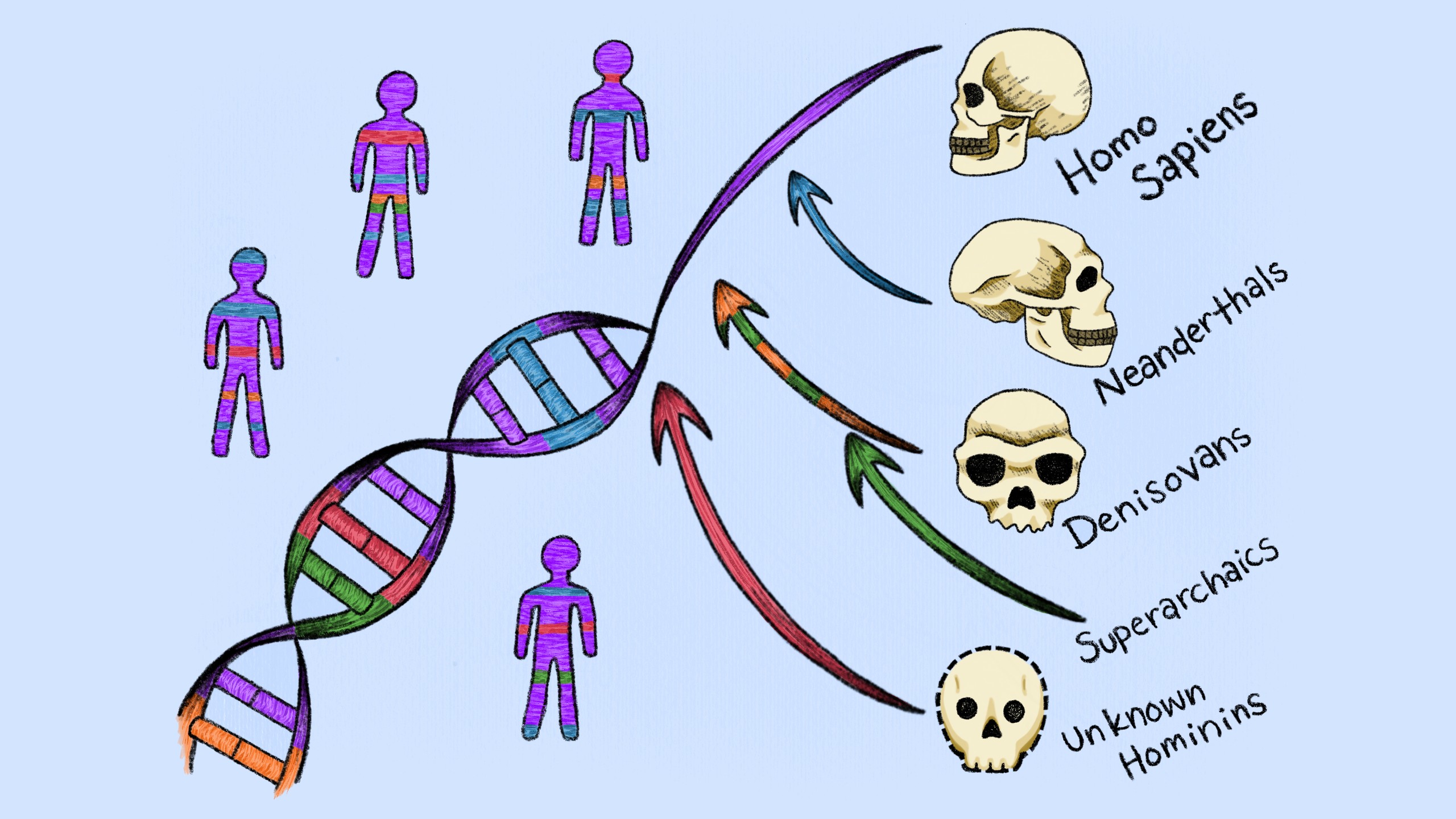
New research has identified traces of two “ghost” human lineages hidden inside modern genomes. One lineage shares its DNA with every person on Earth. The other is a “super-archaic” group that diverged nearly two million years ago.
These findings were reported July 30 in the journal Science.
“This work reinforces a fundamental shift in how we perceive human evolution,” said Priya Moorjani. She is a human evolutionary geneticist at UC Berkeley. “Rather than a simple branching tree… human history is increasingly emerging as a complex web of populations connected by repeated episodes of divergence and mixing.”
The study challenges the idea that modern humans (Homo sapiens ) evolved in isolation. Instead, it shows we are the product of multiple interbreeding species. Hybridization appears to be the norm. Not the exception.
Why Ancient Ghost Lineages Matter for Modern Genetics
For decades, scientists knew that non-African humans carry about 1–2.4% Neanderthal DNA. Asians and Oceanians also harbor 0.1–6% Denisovan ancestry. But experts suspected there were other, unidentified groups involved.
These unknown contributors are called “ghost lineages.”
Finding them is difficult. Ancient DNA degrades quickly. It survives only in cold, dry environments. This leaves Africa and other tropical regions largely untouched by traditional archaeological genetics. We lack the fossils to identify who these groups were.
“Ancient DNA has transformed our understanding… but it can only tell us about populations where DNA has been preserved,” Moorjani noted.
The new study changes the game. Researchers developed a method to scan over 500 complete modern genomes. They did not need fossils. They relied on genetic genealogy reconstruction. By mapping every divergence and merge in family trees, they looked for stretches of DNA that broke from the common human ancestor line far back in time.
If a genetic segment’s ancestor lies much further back than the standard split, it signals an ancient interbreeding event.
The “Super-Archaic” Signal in Oceanian DNA
One of the most striking discoveries involves a lineage that split from our ancestors roughly 1.8 million years ago. This “super-archaic” group predates the common ancestor of humans, Neanderthals, and Denisovans.
Evidence of this ancient mixing is found specifically in people from Oceania.
On average, this super-archaic DNA makes up 0.002% of Oceanian genomes. It appears within regions known to be Denisovan. This suggests the super-archaic material entered modern humans through Denisovan interbreeding.
Who was this lineage?
Fernando Villanea, a population geneticist, suggests Homo erectus. H. erectus is the longest-surviving human species. The timeline fits. Skulls found in Yunxian, China share features with Denisovan fossils. But only limited H. erectus genetic material has been analyzed so far. The ghost remains largely unproven genetically. Still, the signal is there.
How Modern Humans Inherited Ghost Ancestry from Africa
The second ghost lineage is different. It is not restricted to one region.
It is present in all modern humans.
This indicates the interbreeding event happened in Africa. It occurred more than 50,00 years ago. This predates the major H. sapiens migration out of Africa.
Yulin Zhang, another lead researcher, explained that previous studies debated whether unknown archaic ancestry was African-specific. They couldn’t confirm the timing. The new method changed that.
“We were actually able to find and map genomic locations in modern humans that are from this ghost lineage,” Zhang said. “And show that this ghost ancestry is in all modern humans, not only in Africans.”
This DNA comprises about 0.5% to 2% of modern genomes. That is comparable to Neanderthal contributions. The lineage diverged roughly 800,00 years ago. The same time as the Neanderthal-Denisovan split.
Candidates for this group include Homo heidelbergensis. This species lived in Africa and Europe from 700,00 to 200 years ago.
Chris Stringer of London’s Natural History Museum agrees with the speculation. H. heidelbergensis was present in Africa as recently than 300,0 years ago. The timeline matches.
Immunity, Metabolism, and the Cost of Mixing
The ghost DNA segments are not randomly placed. They cluster in specific areas.
Most are found in genes linked to the immune system. Others relate to metabolic function.
Why here?
Moorjani argues it makes sense. Adapting to new germs and food sources is a primary driver in human evolution. Interbreeding provided a quick way to acquire beneficial variants. Neanderthal and Denisovan genes offered advantages in new environments. These ghost ancestors likely provided similar boosts.
This supports the view that human evolution is a messy, interconnected web.
“We see hybridization being a common trait,” Villanea said. “These findings help us reframe our scientific thinking away from a mentality of human exceptionalism.”
The method is already proving useful beyond just identifying past ghosts. It can reconstruct genomes of primitive species like H. erectus. It can study other species where fossil DNA is absent.
The goal is to look deeper. Researchers want to find more ghost lineages. Particularly from underrepresented regions like Africa and South Asia.
We are only just beginning to read the hidden history in our blood. And the story is more tangled than we ever imagined.