Earth is roughly 4.7 billion years old. Geologically speaking, that’s an eternity. Yet life didn’t take long to kick in. It showed up within a billion years. Simple. Liquid-bound. The early oceans and swamps were the nurseries for these first single-celled entities. They didn’t stay alone for long. Multicellular organisms soon joined the party.
Then came the game changer. Photosynthesis.
Some aquatic organisms figured out how to harvest light energy. This wasn’t just a survival trick. It was the origin story of the plant kingdom. But staying in the water is a safe bet. Moving to land? That’s a nightmare of dehydration and UV radiation. The transition wasn’t smooth. It was brutal.
Plants didn’t just walk onto dry dirt. They had to engineer themselves first. They needed armor. An epidermis and cuticle to stop them from drying out or getting sunburned. They needed plumbing. A vascular system to conduct sap against gravity. They needed structure. A “skeleton” to hold themselves upright. And they needed reproductive safeguards. Protective layers around their spores.
It took time to get these parts working together. The first true land plants didn’t appear until about 460 million years ago. During the Ordovician period. That’s a long wait after the Earth formed. But once they made it, the world changed forever.
Tiny Beginnings: What Devonian Plants Actually Looked Like
Most Devonian plants were barely visible. We are talking about organisms less than one centimeter tall. They lacked roots. They had no leaves. Instead, they relied on specialized structures called sporangia to release spores for reproduction.
Most of these early green pioneers belonged to the Bryophytes group. You know them today as mosses. Crucially, they did not possess vascular tissue. This means they lacked the cells needed to conduct sap. Without internal plumbing, staying upright and transporting nutrients was a constant struggle.
The First Vascular Plants
The shift toward complexity happened slightly earlier, in the Silurian period. Around 435 million years ago, the first true vascular plants emerged.
The standout example here is Cooksonia .
This genus is significant because it possessed conducting cells. It was the ancestor of more complex flora that would dominate the later Devonian. Cooksonia didn’t vanish immediately. It persisted well into the Early Devonian, serving as a bridge between the simple moss-like ancestors and the towering forests to come.
The Devonian Plant Explosion
The Devonian period wasn’t just a time of fish. It was when plants actually figured out how to stand up.
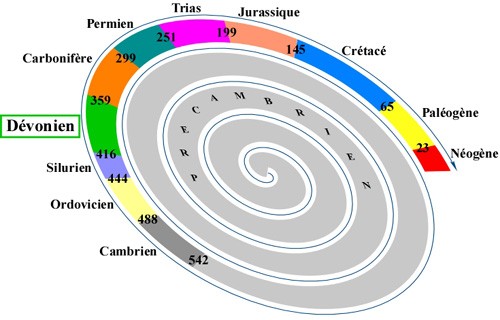
Between 416 and 359 million years ago, the green world hit a gear. Cooksonia was the pioneer, but it was just getting started. We’re talking about the first real roots. The first primitive leaves. The first clumsy attempts at seeds.
This wasn’t gradual evolution. It was an acceleration.
Think about what that means for the landscape. Before this window closed, land was basically sterile rock and dust. Then, suddenly, vascular tissue. Structures that could hoist water against gravity. Structures that could anchor into dirt that didn’t exist yet.
“First roots and leaves, primitive seeds…”
The reconstitution of Cooksonia’s aerial parts shows us the blueprint. Simple, dichotomous branching. No true leaves. No true roots. Just sporangia perched on tips. But it worked. It conquered the terrestrial environment with terrifying efficiency.
Why does this matter now? Because every tree you’ve ever touched owes its basic architecture to this Devonian scramble. The innovation wasn’t just survival. It was colonization. The land didn’t just host life anymore. It became part of the life cycle itself.
The story of plant evolution didn’t end with Cooksonia. The species shown in Figure 4 is distinct from those in Figures 3 and 5. It features more rounded sporangia. This small morphological shift signals a larger evolutionary leap.
The structural refinement of the stem was the catalyst. It allowed for the invention of the tree. It paved the way for the first forests.
In just a few million years, early plants broke free from aquatic environments. They conquered nearly every terrestrial ecological niche. The planet transformed. Fossils from this era are found everywhere.
Here are some of the most representative and intriguing examples.