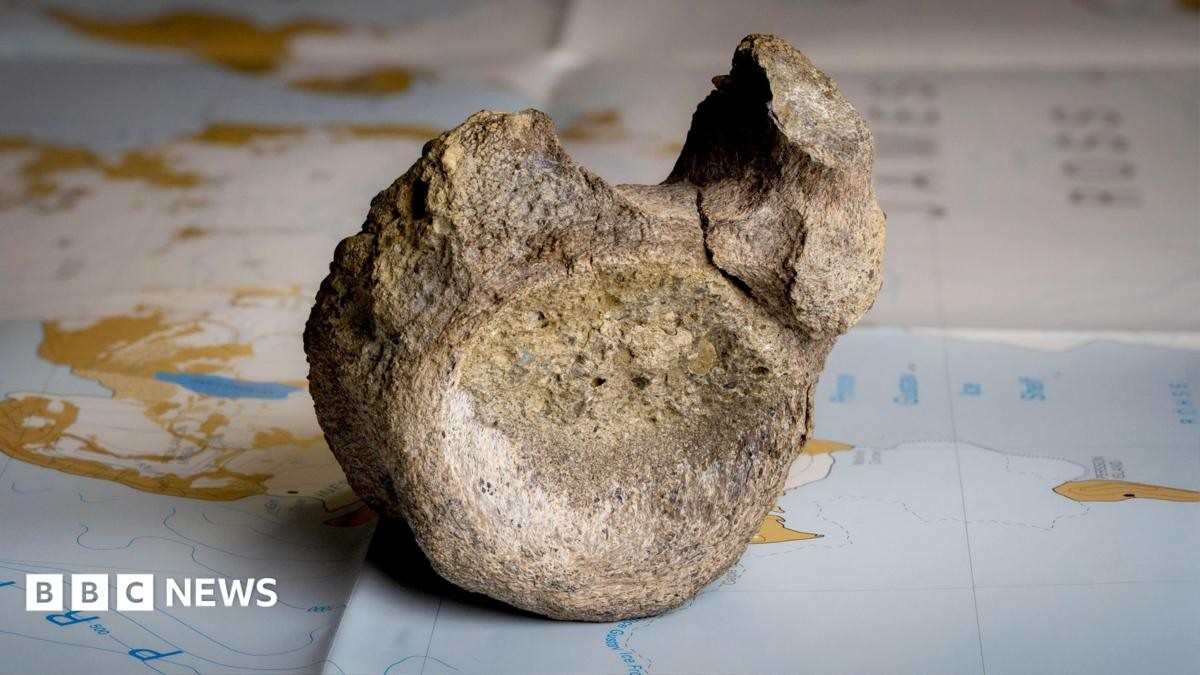
A fossil sat in a box for forty years.
Forgotten. Misfiled. Just another piece of rock to everyone except one guy who happened to be cleaning.
Dr Mark Evans is the collections manager at the British Antarctic Survey in Cambridge. His job involves sifting through thousands of specimens dragged back from expeditions over decades. One day, he started thinking about what was actually sitting in a specific drawer. You know the feeling. You open a cabinet, move a rock aside, and something catches your eye. This looks interesting.
Turns out it was the first dinosaur bone ever found on Antarctica.
The specimen was pulled out of the ground back in 1985 on James Ross Island. A geologist named Dr Mike Thomson recorded it in a field notebook. He drew a tiny, neat sketch and wrote vertebra of large reptile. He noted it was about 10 centimeters wide. At the time, the team assumed it was from some kind of marine lizard. They weren’t sure what it really was, so they stored it away in the geology collection and moved on with their lives.
Fast forward to now. Evans realized the vertebra didn’t look like a marine reptile. It looked dinosaur-like. And not just any dinosaur. The date stamped on its discovery meant if this was real, it beat every other find on the continent to the punch.
He called Paul Barrett, a professor at the Natural History Museum. Barrett held the fossil in his hands.
“Although it’s not too much to watch at, it has a really distinctive shape.”
Barrett pointed out a hollow on one end and a rounded bump on the other. These features create ball-and-socket joints. From head to tail, that’s how titanosaurs built their spines. Barrett wasn’t guessing.
“This is a combination of features that’s completely unique to these types of dinosaurs.”
He identified it as a Titanosaur. That’s the group that included the absolute giants. The largest walked the Earth weighing sixty tonnes, stretching more than 115 feet long. They were four-legged plant-eaters with necks that seemed to go on forever, designed to strip leaves from tall trees. Their long tails acted as counter-weights, balancing the heavy business at the front.
This one wasn’t that big, though.
Based on the size of that single tail bone, scientists estimate the Antarctic ancestor was only about 23 feet long. That’s tiny for its family.
“Maybe it was a juvenile,” Barrett says. Or maybe it was a genuinely small adult, a rule-breaker bucking the trend of its massive cousins.
It doesn’t matter too much what its full name was, or how fast it could run. What matters is what its existence implies about the world back then.
This beast lived 82 million years ago. Late Cretaceous. Antarctica wasn’t an ice sheet then. It was different. Lush forest covered the ground, providing plenty of food for a plant-eating dinosaur wandering through what we now imagine as a frozen wasteland.
The fossil record in Antarctica is sparse, which makes every single bone count.
We tend to think of the continent as dead, or at least frozen in time since the glaciers took over. But for tens of millions of years, it was alive with things that moved and ate and died in the snow-free dirt. Now we have a tiny piece of bone to prove it.
Evans found it in a drawer. Imagine that. The most important clue about Antarctica’s deep past wasn’t locked in a vault. It was hiding under a pile of ordinary rocks, waiting for someone to look twice.