Modern birds have it easy. Short tail. Fused bone clump at the end. It holds feathers tight, anchors flight, and looks nothing like a dinosaur’s long, rattling stick of vertebrae.
That stick was what came before.
Their ancestors had dozens of tail bones. Dozens. How they got from that to this has always been the tricky part of ornithology. Fossils don’t keep good records of the messy middle. Or rather, they don’t seem to exist. Until now.
A small new fossil from China fills a hole in the narrative.
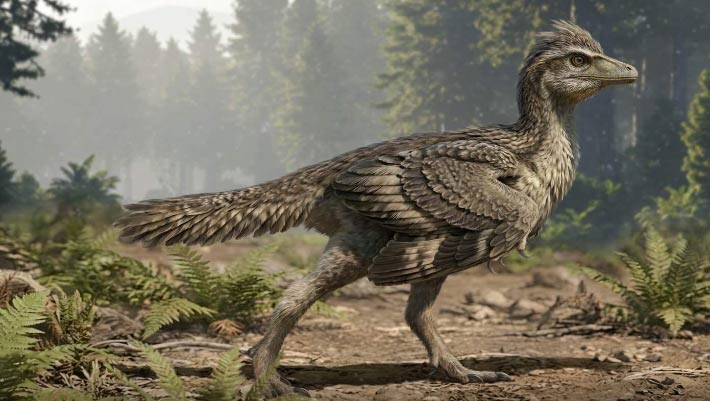
Called Zhengheornis buyi, it’s a Jurassic bird. Found in 2024. Tucked away in the Nanyuan Formation, near Yangyuan village, Fujian province. It’s old—148 to 150 million years old. Right at the tail end of the Jurassic. The era when early birds started getting ideas above their station and diversifying fast.
It’s tiny. Really tiny.
Researchers pegged its weight at 74 to 164 grams. For context? It’s lighter than the Archaeopteryx specimen most people point to when they want to show you how small “ancient” birds were. This isn’t just a bird. It’s the smallest known adult non-pygostylian therapod we have ever seen.
But look at the tail.
Here is the surprise. Zhengheornis has a short one. Just fifteen vertebrae. Compare that to Archaeopteryx, which hauled around 23 or 24, or other cousins dragging 30 plus. But here is the catch. The bones didn’t fuse.
No pygostyle. No single fused lump at the base. They stayed separate.
This matters because evolutionary biologists have long argued such a thing couldn’t exist. They thought it was biologically impossible. That long tails and short, fused tails just… switched places overnight in the fossil record. No intermediates. Just a hard cut.
Dr. Zhonghe Zhou of the Institute of Vertebrate Paleontology called it out bluntly.
“Evolutionary biologists have long argued that a species having an abbreviated but unfused bony tail was improbable. We proved them wrong.”
The tail also has some weird shape quirks. The last two bones look like little boxes. A shape usually reserved for Caudipteryx, a dinosaur relative that lives in a completely different part of the family tree.
It challenges the idea that everything happened together. Shortening the tail and fusing the bone used to be assumed as one move.
Dr. Min Wang and her team say otherwise. They argue it was stepwise. First, the spine shrank. Then it fused. Later.
It’s a mosaic anatomy. One trait evolving faster than the other.
“This proves a stepwise path,” Dr. Wang noted. “Vertebral reduction came before fusion.”
So why do we care?
Because this little guy helps untangle when birds started exploding into different niches. It wasn’t strictly a tree hopper. It wasn’t a sprinter. It sat somewhere in between, while its neighbors like the fast-running Fujianvenator handled the ground running.
Different sizes. Different skeletons. Different goals.
This suggests birds hadn’t just showed up late to the Jurassic party. They were already working. A major adaptive radiation had likely begun. The “big bang” of bird evolution might not have waited for the Cretaceous.
Does it resolve the debate on timing? It helps. Maybe settles it. The paper, out in Science Advances this month, gives us the missing link between the long dinosaur tail and the bird’s aerodynamic rudder.
It turns out the middle wasn’t so impossible after all. It just took a very small bird to prove it.