New species. That’s the news. Usually it happens via DNA sequencing or someone dragging a microscope lens to its limit. Sometimes you have to trek somewhere truly miserable. But this one? They missed it for centuries.
Primatologists just confirmed it. Colobus congoensis.
It lives between the Lomami and Lualaba rivers. East-central Democratic Republic of Congo. A rainforest labyrinth. Local people saw it occasionally, mostly ignoring it or giving it a nod and a local name. The Bangala called it ‘Likweli’. The Mituku knew it as ‘kasaba nkoni’, which translates to ‘branch-shaker’. Apt, given the tree-dwelling habit.
“It doesn’t look impressed.”
Conservationists Bernard Ikembelo and Ashleyvosper got the first blurry photos in 2008. They were in Lomami National Park back then, though it wasn’t officially a national park until 2016. Just a glimpse though. Enough to scratch a head, not enough to change textbooks.
Nearly twenty years passed. Nothing.
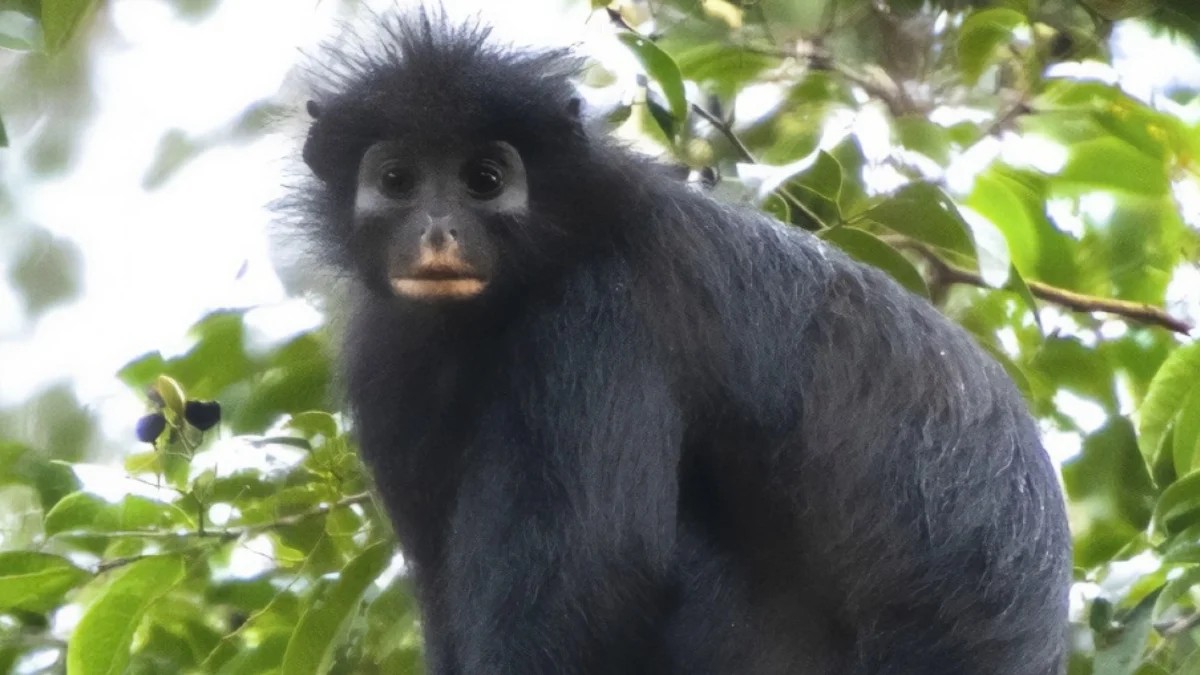
Then, in November 2018 Jean Pierre Kapale went out on a surveillance patrol in the Courbure sector. He took a picture. There was the black monkey. Pale markings around its mouth. A white patch near its tail. Weird.
The team went looking for more. Seven months later, they had seven more photos. Different locations. Same monkey.
Between 2018 and 7,022, the researchers tallied 114 distinct sightings. Across 1,70 square kilometers. That data pushed Colobus congo into the light. PLOS One published the paper.
Junior Amboko, a biologist from Florida Atlantic University, helped name it. He says the discovery is personal. A reminder of how much biodiversity exists right there in the DRC, waiting for someone to look closely enough.
Colobus congo fits the bill. The name honors the country. It’s the first primate named for the DRC itself. Pride point secured.
The look is distinct. Sleek black fur. Long drooping tail. Hair standing up around the face like static electricity hit it. But it’s the face that draws the eye. Curious dark eyes. Sharp cheekbones. Pinkish-orange lips that look like they’re holding back a secret opinion on everything they see.
Genetically it is distant from its nearest relative. Colobus satanas lives 1,20 kilometers away, in west-central Africa. Four million years separate them. Five, maybe. One of the oldest splits in the genus.
Acoustics confirm it too. Six audio recordings. The roars sound unique. Not just different pitch. Different structure.
So, it is new.
That’s the good part.
The bad part is why we found it now. Its range is small. Habitat is disappearing. Hunters are active in the area. We found a species that might have vanished before anyone cared to record its name.
Kate Detwiler from Florida Atlantic calls it a triumph and a warning. Some of the rarest creatures on Earth slip into extinction without a headline. Or a hashtag. Or even a picture.
“Some of Earth’s rarest creatures may perish before the world ever learns their names.”
The research is public. The photos exist. For now, that’s enough. Maybe.
Until the trees fall again.