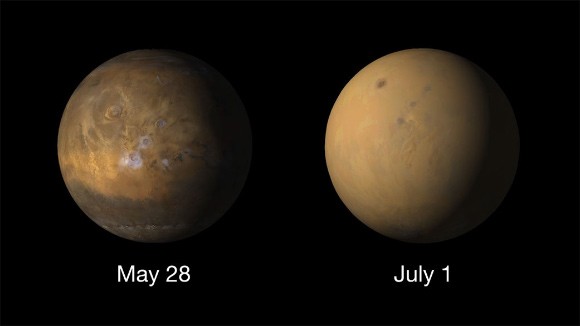
Mars is not just a dusty red rock. It’s a dynamic place. And sometimes, the Sun has a say in its climate.
Planetary scientists have uncovered something surprising. Bursts of energetic particles from the Sun might warm the lower atmosphere of Mars. This happens specifically during massive dust storms. It’s an unexpected link. Space weather meets local climate.
“Solar energetic particle (SEP) events are driven by solar flares and coronal mass ejection (CMEs),” explains Lana Williams, an astronomer at Lancaster University. Her team points out that these blasts release high-energy charged particles. Mars gets hammered by them. Why? Thin atmosphere. No strong global magnetic field. Earth has one. Mars does not.
Previous studies showed these particles ionize the upper atmosphere. They cause diffuse aurorae. They mess with radio signals. But the lower atmosphere? Where weather happens? Not much known. Dust storms naturally heat this region by absorbing sunlight. That’s standard stuff.
But this heating pattern? It was weird. Unusual for a storm alone. The researchers realized the storm couldn’t explain it all.
Williams and her team looked at five specific SEP events at Mars. They wanted to see if long-lasting bursts could warm the lower levels. Four events? Nothing clear. No sign of extra heat. Then came the fifth one. June 2018.
It coincided with an expanding global dust storm. The storm that killed NASA’s Opportunity rover.
During that specific event, they found signs of lower atmospheric heating. “We expected some effect on temperatures, but only saw clear evidence during the global storm,” Williams notes. The coincidence suggests interaction. Not independent actions. The atmosphere responds to multiple drivers at once.
To figure this out, they used data from two key orbiters. NASA’s Mars Atmosphere and Volatiles EvolutioN (MAVEN). ESA’s Trace Gas Orbiter. They compared observations with expected profiles from the Mars Climate Database. They tracked temps before, during, and after each SEP event.
“Dust storms weren’t even part of our original plan,” Williams admitted. Finding them paired with the heating was the surprise. It points to complex interplay. Space weather plus local conditions.
These findings were presented this week at the 2026 NAM Meeting in Birmingham, UK.
Lana Williams et al. Do solar energetic particle events impact lower-atmospheric temperature on Mars? NAM2026.