Sound doesn’t leave bones. It doesn’t fossilize. Try digging up a scream from the Pliocene. Good luck with that. So when scientists want to understand where human voice comes from, they hit a wall of silence. Unless you look at laughter.
A new study from the University of Warwick and Portsmouth just turned the volume up on our deepest ancestry.
Rhythm in the Roots
The basic idea? We aren’t special. At least not in how we start laughing.
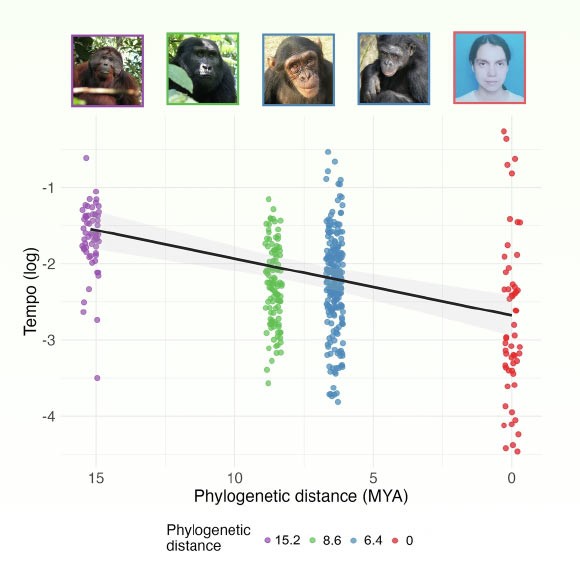
The rhythm. That rapid, bouncing cadence? All great apes share it. Orangutans, gorillas, chimpanzees. They all hit those notes with the same fundamental timing. It suggests a common ancestor—gone 15 million years—was already chuckling in a way that would look recognizable to us today.
“Comparative studies… provide the only extant model of extinction vocal capacities.”
Without fossils for sound, these apes are our living archives.
The Data
They recorded 17 primates. Including humans.
The lineup: four orangutans, two gorllas, three bonobos, four chimps, and four people. The humans ranged from six-month-olds to seven-year-olds. They tickled them. They let them play.
The result was striking. Across the board, laughter is isochronous. Bursts of sound happen at even, regular intervals.
Music works the same. Speech does too. This rhythmic lock-step isn’t new. It’s ancient. Conserved.
But evolution is messy. As the species line draws closer to us on the tree, the laughter changes.
Getting Closer, Getting Faster
It speeds up.
Variability creeps in. The timing gets less rigid and more dependent on the social room they’re in.
Humans? We break the pattern completely. We’re the only ones who shift tempo based on context. Tickle fight? Fast, frantic bursts. Quiet social play? Different rhythm entirely.
Robotic laughter sounds cold. Flat. But the messy, variable stuff? We hear that as warmth. It carries real social weight. Flexibility is the signal.
“Laughter… provides a rare evolutionary window into vocal transformations.”
Not a Switch, But a Slider
Forget the old story.
You know the one. Primitive ancestors grunt for eons, then suddenly pop —Homo sapiens acquire full vocal control in a blink.
No. The researchers argue this view is wrong.
Humans aren’t a sudden break. We’re a prolongation. A continuation of abilities honed over 15 million years. The capacity didn’t appear overnight. It evolved. Incrementally. Along a continuum that connects us to every great ape still walking the earth.
It changes how you hear your own voice.
We think we’re distinct. Complex. Separate from the rest of the animal kingdom. Maybe.
But the next time you hear someone laugh—that erratic, human, beautifully timed burst—remember where it starts.
Fifteen million years back. In the dark.
The joke has been going on forever.