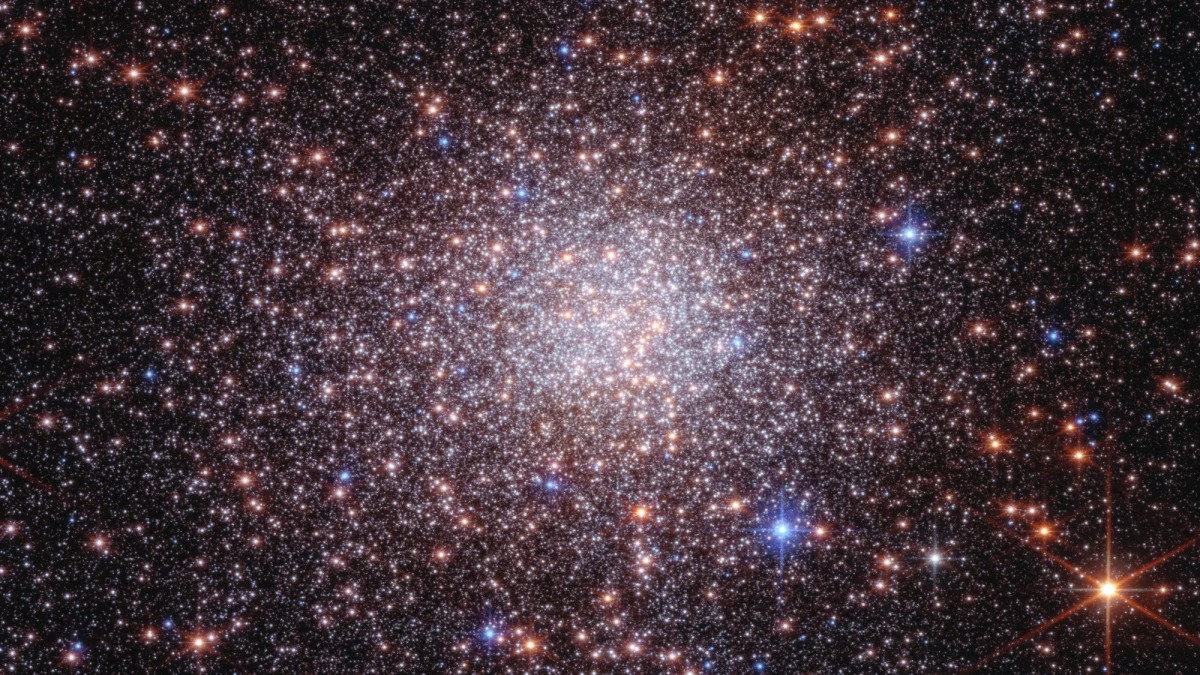
Terzan 5 isn’t just a blob.
It looks like a standard globular cluster from a distance. Dense. Old. Boring, almost. Astronomers named it after Agop Terzan back in 1968, expecting nothing more than a handful of ancient stars clinging to each other in the void.
Expectation is a fragile thing in space.
New data from the James Webb Space Telescope changes everything. When combined with twenty years of Hubble images, the picture sharpens into something unsettling. Terzan 5 doesn’t hold one population of stars. It holds four.
Four generations of stellar birth.
The first wave ignited 12.5 billion years Ago. Then silence for a long time. Then another burst around 4.7 billion years ago. Followed by pulses at 3.8 and 2.5 billion. That is not how normal globular clusters work. Normal clusters are monoliths. Static. Dead ends.
This is a timeline.
“This is like a kind of a kind of a galaxy in a bottleneck” – R. Michael Rich
Rich speaks for the team at UCLA. The chemistry backs him up. Inside this cluster, massive stars went supernova. They dumped heavy elements into the surrounding gas. Then Type Ia supernovas – exploded white dwarfs – added iron. Over billions of years, lighter stuff like oxygen and magnesium faded.
Recycling gas. Making new stars. A loop.
That only happens if the system was massive enough to hold onto that gas in the first place. And that leads to the uncomfortable truth about Terzan 5.
A broken relic
It sat in the Milky Way’s bulge for too long.
Sitting 3,000 light years from the galactic core, the cluster was surrounded by gravity well so deep it acted like a vacuum cleaner. The Milky Way stripped Terzan 5 bare.
Francesco Ferraro calls it a “bulge fossil fragment.” I prefer “cannibalized evidence.”
To separate the cluster members from the galactic noise, researchers treated the sky like a flock of birds. If the bird moves with the group, it belongs to Terzan 5. If it wanders off on its own weird path? That’s just a random star passing through the foreground or background.
“The other birds are stars in the bulge.” Rich explains. “But they’re flying around kind randomly.”
Right. Random chaos vs structured movement.
Today Terzan 5 weighs only 1 or 2 million suns. Tiny for its age. But the math suggests it started life heavy. Perhaps as massive as one billion suns. It wasn’t a cluster when it formed. It might have been a dwarf galaxy.
It gave most of itself to the Milky Way.
Dark matter? Black holes?
Now they’re digging through the leftovers.
There are hints of things unseen. Stars on the edge of the cluster are moving faster than physics should allow for visible mass alone. Someone, or something, is pulling on them.
Two possibilities exist.
- Dark matter. If Terzan 5 hosts dark matter, it would be the first globular cluster known to do so.
- A supermassive black hole.
Rich isn’t jumping to conclusions yet.
“We are presently doing detailed analysis… whether we need something else,” he said. That “something else” could rewrite the textbook on how these dense clusters evolve. Or disappear entirely into the galactic center.
No black hole evidence yet. No confirmed dark matter either.
Just a battered shell floating near the galaxy’s throat.
Webb is still counting. Searching for the faintest low-mass stars that survive the striping. Every star counted adds another piece to the reconstruction of what used to be there.
What if most clusters aren’t born small?
What if they’re born giant and get eaten alive?
Terzan 5 might be the Rosetta Stone for understanding how our own galaxy built its bulge. But the story doesn’t end with a neat bow. The data keeps shifting. The edges are blurry.
And out there in the dark, there are probably thousands more fragments waiting to be found. Just like this one. Quietly dissolving.