They finally saw it. Not inferred. Not guessed at.
For a long time, we assumed the space between stars was a rough place. It’s called the interstellar medium and it churns with clouds of ionized gas, electrons, all sorts of messy plasma. You can’t really see it. But you can see what it does to other things.
Think about heat rising off pavement. The wobbly shimmer. That distortion behind a fire? This is that, but in space, happening to radio waves coming from ten billion light-years away.
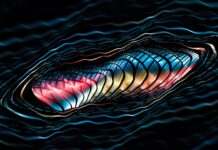
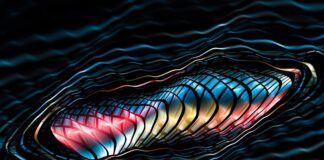
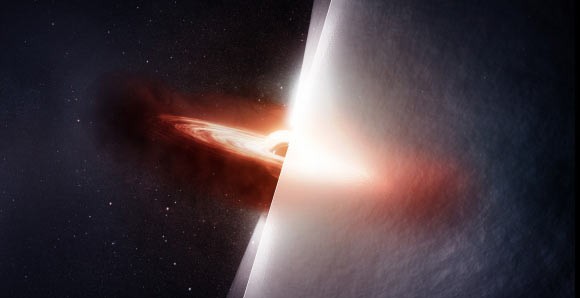
Astronomer Alexander Plavin and team at Harvard & Smithsonian decided to test the theory properly. They picked a specific quasar, TXS 2005 403, sitting out in the Cygnus constellation. Supermassive black hole. Bright. Far. Very far.
As the light travels here it crosses a particularly chaotic patch of our own Milky Way. It bends. It smears. It distorts.
“Most of what we see isn’t the quasar,” Plavin noted. It’s the scatter. The turbulence leaving its fingerprint on the signal.
The team dug up nearly ten years of old data from the VLBA. They expected the distant telescopes to see nothing. Or maybe a faint, smooth blur fading into the noise. Standard physics suggests the signal should smear out until it’s unrecognizable over those baselines.
It didn’t.
The scattering properties remain persistent.
They found patterns. Distinct ones. Patchy. Structured. It wasn’t simple blurring. The signal survived in places it theoretically shouldn’t have, showing up in the data exactly where turbulence models predicted it would behave.
“We clearly detected its signal,” Plavin said. The faint glow refused to cooperate with simple explanations.
Why did this matter before? We could guess the turbulence was there. Now we can see its structure. Directly. In print, at least, in The Astrophysical Journal Letters.
The universe is noisy. Always has been. Now we know the noise has texture.
Which leaves me wondering. What else are we missing because we’re looking for clean lines where none exist?
Plavin et al. 202. ApJL.