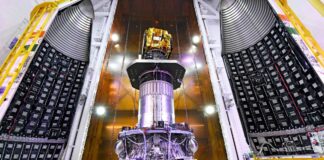
SpaceX has successfully completed a critical milestone in the development of its most powerful rocket yet. On Tuesday evening, April 14, the company conducted a full-duration static-fire test of the Starship Version 3 (V3) upper stage, firing its engines while the vehicle remained secured to the launch pad.
This successful test marks a significant step forward for the “Version 3” architecture, which is designed to vastly outperform all previous iterations of the Starship megarocket.
Scaling Up: What Makes Version 3 Different?
The transition from Version 2 to Version 3 is not merely an incremental update; it is a substantial leap in both scale and capability. The new configuration offers several key improvements:
- Increased Height: The V3 stack stands at 408.1 feet (124.4 meters), making it roughly 4 feet taller than the V2 model.
- Massive Payload Capacity: According to SpaceX CEO Elon Musk, the V3 is engineered to carry over 100 tons to Low Earth Orbit (LEO). This is a nearly threefold increase compared to the ~35-ton capacity of the V2.
- Enhanced Propulsion: The increased lifting power is driven by the new V3 Raptor engines, which provide the necessary thrust to manage the vehicle’s larger mass and higher payload requirements.
This leap in capacity is vital for the long-term goals of SpaceX. To move from simple orbital tests to meaningful space exploration, a rocket must be able to deliver massive amounts of cargo, fuel, and life-support systems into orbit in a single launch.
The Road to May
This successful upper-stage test follows a previous trial of the V3 first stage (the booster) conducted four weeks ago. That earlier test was limited, involving only 10 of the booster’s 33 Raptor engines and ending prematurely due to ground equipment issues. By completing a full-duration fire on the upper stage, SpaceX has cleared a major technical hurdle for the upcoming flight profile.
The company is now targeting a landmark launch in early or mid-May. While this will be the 12th overall Starship flight, it will be the first flight of the Version 3 vehicle, representing a new era for the launch system.
The Artemis Connection: Why This Matters for NASA
The success of the Starship program is inextricably linked to NASA’s Artemis program, which aims to return humans to the lunar surface.
NASA has selected Starship to serve as the first crewed lunar lander for the Artemis missions. Following the recent success of Artemis 2, which sent astronauts on a lunar flyby, the focus shifts to Artemis 3. This upcoming mission will be a decisive test of lunar landing capabilities, requiring Starship to demonstrate:
1. Reliable docking operations in Earth orbit with the Orion capsule.
2. The ability to safely land astronauts on the Moon.
The ability of SpaceX to rapidly iterate through these versions (V2 to V3) is essential to meeting the rigorous timelines and heavy-lift requirements set by NASA for deep-space exploration.
Conclusion
The successful static-fire of the Starship V3 marks a pivotal shift from experimental testing to high-capacity heavy lifting. This milestone brings SpaceX closer to delivering the massive payload capabilities required to fulfill NASA’s ambitious goals for lunar habitation and beyond.