It landed on a boat.
Or rather, it was caught by a net.
China’s Long March-10B just proved it can return its booster stage safely. A big deal for the space race.
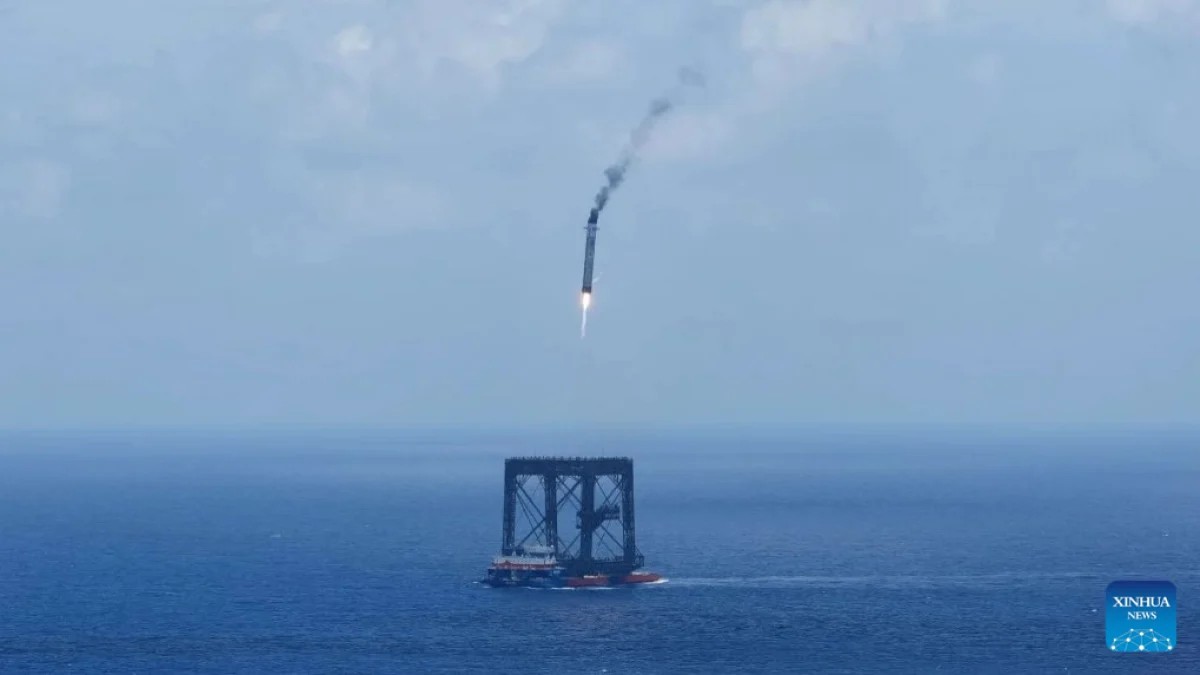
Xinhua reported the launch Friday. Off the coast of Hainan Province, the rocket went up, dumped its payload into orbit, and left the heavy first stage to handle the hard part. The descent.
Instead of splashing down—crashing into the ocean to be hauled up by ships that take forever to process it—the booster turned around. It flew back. It guided itself toward a specialized recovery vessel.
A giant, cross-shaped arresting net was waiting.
The booster didn’t use legs. No touchdown pads, no landing gear clunking onto concrete or deck steel. Just a massive catch. Hooks on the booster engaged the net, cables absorbed the kinetic energy, and the heavy machine hung there. Still. Suspended.
It’s a fully automated process. The rocket flies in, gets grabbed, and hangs in the center.
Why go to the trouble of building a massive 470-foot-long ship and a high-tech LIDAR tracking system?
Money.
Reusable rockets mean flying the same hardware again. Again. Again. This turns space launch from a rare, exorbitant event into routine logistics. The United States has had a head start. SpaceX landed its Falcon 9 in 2015. They’ve since gotten good enough to catch Starship boosters with mechanical arms they call chopsticks. Even Blue Origin managed to land a New Glenn booster on a barged platform before things went sideways for them in May.
Now China is in the mix.
The Long March-10 booster endured what officials called a “six-minute extreme return journey.” It coasted. Adjusted its angle. Fired engines to brake against the air itself. The waiting vessel used real-time sensors to guide that net into position.
Chen Muye of CASC —the state-owned aerospace giant—said this is a breakthrough for low-cost heavy lift. He called it key to commercial competitiveness.
But there’s a mechanical trade-off that makes the net interesting.
Legs are heavy. Complex mechanisms are heavy. By catching the rocket mid-air, engineers don’t have to bolt landing struts onto the booster. Less weight on the rocket means more room for satellites. The Long March-10B is liquid-fueled, stands over 200feet tall, and pushes nearly 1,000 tons of thrust at lifft-off. In reusable mode, it carries up to 18tons to low-Earth orbit.
That capacity targets the booming commercial market. The internet-constellation crowd wants to move fast and cheap.
Did this flight signal a shift in how we think about launch infrastructure?
The booster hangs there, caught in the air. Not resting. Waiting to be processed. The next launch isn’t just about getting up there.
It’s about coming back down without burning it.
We’ll see if the net holds up. Literally.