I’m napping. Twelve meters up. A chimp nest in Uganda’s Toro-Semliking Wildlife Reserve holds me like a cradle made of twigs. It feels engineered. Springy. Stable. Less like a heap of sticks, more like a piece of furniture someone actually sat down to design.
Then I wake up. The drop hits my stomach. I am not in a bed. I am balancing in the sky.
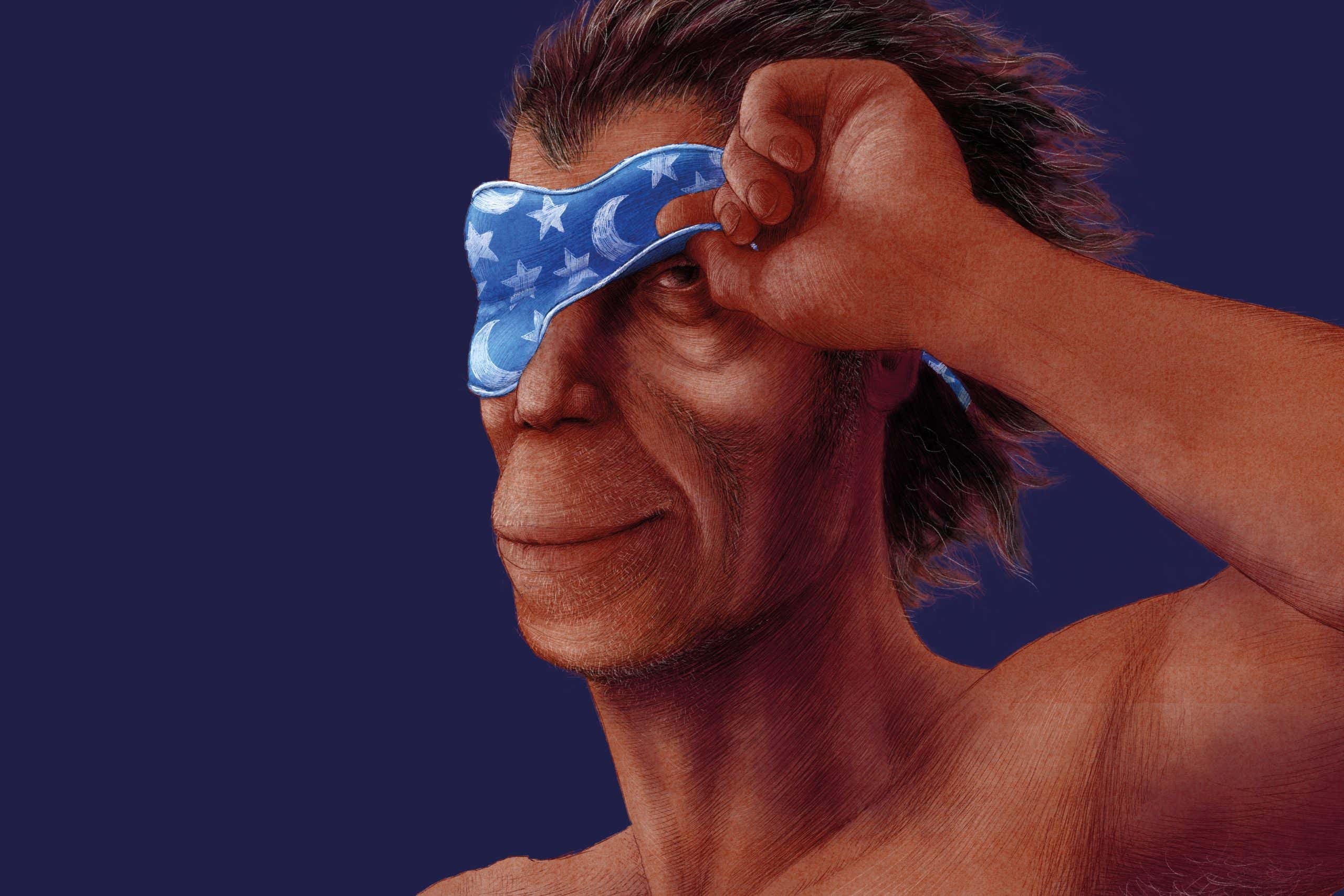
Why did I climb up there? To figure out a problem nobody cares enough about: why do humans sleep so little. It’s an evolutionary paradox. Sleep makes you vulnerable. It stops you from eating. From mating. From noticing the leopard creeping closer. And yet, we do it less than almost any other primate.
We also do it strangely.
If you took a biologist blind to human habits, gave them our stats—body size, brain mass, where we fit in the family tree—they’d guess we need 9.5 hours of sleep a night.
We average 7.
That’s 35 percent less than expected. Less than any of the other 30 primates scientists have tracked. This isn’t because of Instagram scrolls or bad coffee. It’s ancient. Deep in the code.
The cost of REM
Sleep has two main parts. Non-REM (NREM) is the heavy lifting. Muscle repair. Immune boost. Memory consolidation for facts and events. Rapid Eye Movement (REM) is where the brain gets wired like it’s awake. Dreaming happens here. Muscles paralyze. Body temperature regulation switches off. You become a metabolic furnace in a frozen room.
It’s dangerous. It’s costly.
So when humans evolved to sleep less, logic suggests we should cut the expensive parts. Like REM.
We didn’t.
A 2018 study my colleague Charles Nunn and I ran showed humans have the highest percentage of REM among the primates we looked at. Chimps. Orangutans. Lemurs. We beat them all in the REM category.
The math only works because we slashed NREM. Our model said we should get 8.4 hours of deep NREM sleep. We actually get 5.4. We compressed the night. We kept the dreaming brain active and cut the physical repair time.
Is that reckless?
Maybe. Or maybe it was a trade-off for something else.
Down from the trees
Chimps solve the predator problem by building nests. High up. Safe. Some trees they pick even repel mosquitoes. It’s a comfort tech that helped their brains develop object manipulation skills. Better sleep led to better smarts.
Our ancestors didn’t want the comfort. They wanted the ground.
Homo erectus showed up around 1.8 million years old, sleeping on the dirt.
Think about how terrible that sounds from up in a tree. On the savannah floor, you are a snack. You are exposed.
This creates the Human Sleep Paradox. Why evolve to sleep fast and efficiently while standing in a field of wolves? It wasn’t modern life. It wasn’t electricity. It happened way before the first alarm clock.
The SHELL strategy
The answer is that we stopped sleeping as individuals. We started sleeping as a tribe.
Biologists talk about the “extended phenotype.” A beaver doesn’t just swim. It builds a dam. The dam is part of its genetic output. It changes the world.
We did that with sleep.
I call it the sleep exophenotype, or more simply: SHELL.
Shelter
Hearth (fire)
Environmental prep
L ight
Lookouts
We built a shell around our nights.
I studied this with the Hadza people in Tanzania. My assistant Ibrahim Mabulla wore trackers on them. What did we find? Nobody was ever fully asleep at the same time. Over 20 nights, there were only 18 minutes where everyone was knocked out together.
At least one person was always watching.
Vigilance wasn’t a personal chore anymore. It was a shared resource. We distributed the danger across the group. The fire kept things warm. It pushed the predators back. It turned night into social time instead of survival mode.
This was a hidden revolution. Bipedalism gets the glory. Language gets the books. But this? This let us leave Africa.
You can’t survive the cold northern latitudes if you need 20 hours of safe sleep under a rock. But if you have fire. If you have a hut. If you have three other guys watching your back—you can go anywhere.
We carried a habitable night in our pockets.
The shell allowed us to keep the brain-active REM sleep while dodging the vulnerability cost. It let us innovate. Dream bigger. Wake up ready to build.
We are short sleepers because we outsource our safety.
The question lingers. Are we doing it right today? We still have the shells—hotels, bunkers, apartments. But the watch has ended. The tribe has dispersed into rooms.
I look back at the chimp nest. It was safe. But it was alone.