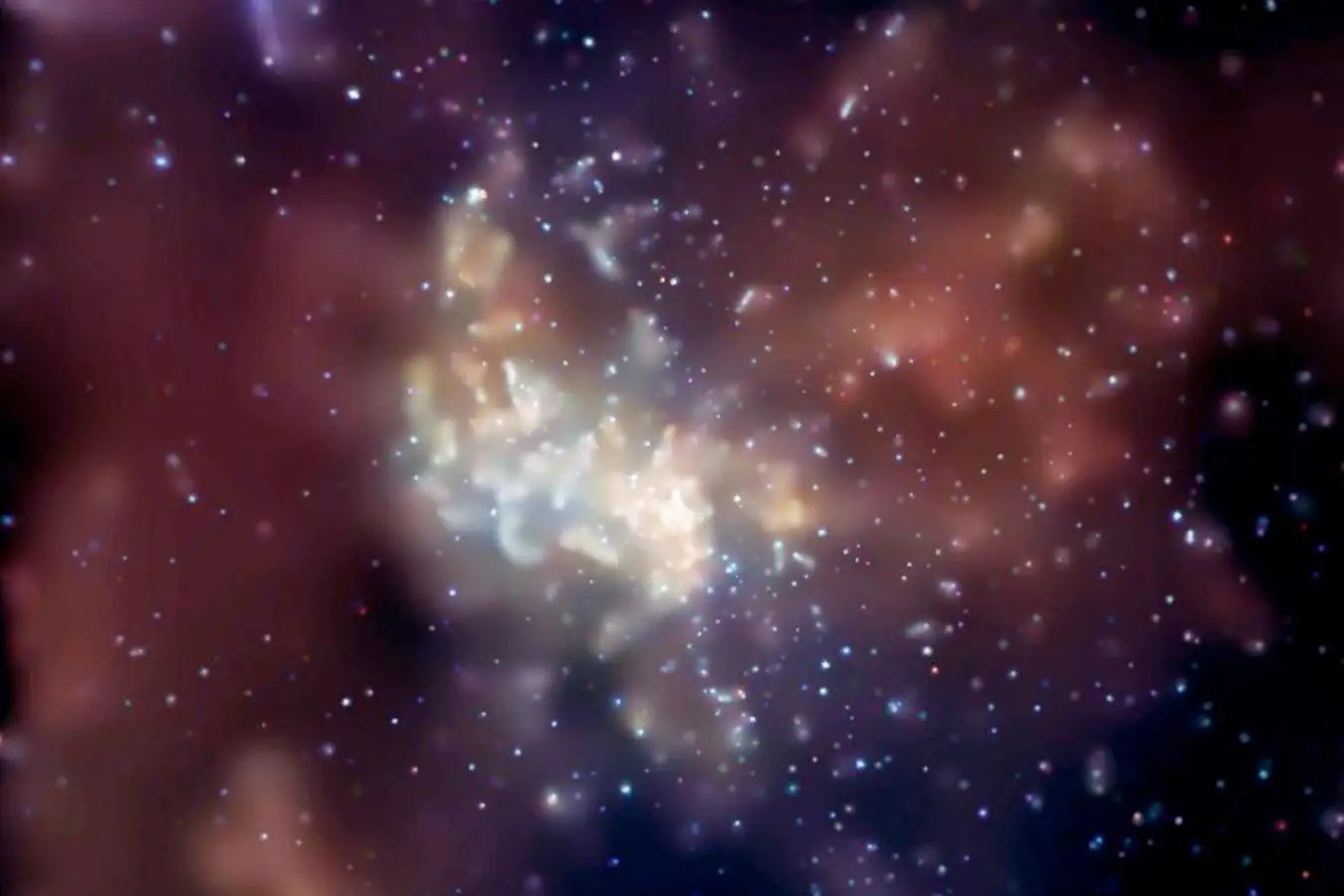
Chaos. That’s what the Milky Way’s heart looks like.
Supermassive black holes are messy neighbors, and Sagittarius A* is no exception. It sits in the middle of three wildly different groups of stars. They’re the same age, roughly. Yet they orbit in ways that make absolutely no sense when viewed through current theories.
Until now.
Xiaochen Zheng and her team at the Beijing Planetarium have a fix. A relatively simple one, at least.
The weird families
First, look at the S-stars. They cling to Sagittarius A*, moving in a spherical swarm on elongated, terrifyingly tight orbits. But there’s a hole in their distribution—a “zone of avoidance.” Just… empty space. Weird.
Then, a bit further out, there’s the clockwise disc. Orderly. Massive stars spinning in a neat circle.
Finally, the off-disc stars. Scattered. Chaotic. Some even circle counter-clockwise, going against the flow of the rest.
Three populations. Three distinct vibes. Scientists have thrown ideas at this puzzle for years. None of them could explain all three groups at once without twisting themselves into knots.
A tilted companion
Zheng’s model introduces a ghost. An intermediate-mass object.
It’s not Sagittarius A*. It’s something smaller—maybe a black hole with a few hundred or thousand times the mass of our Sun. The key? It’s tilted.
Imagine a flat disc of gas and dust spinning calmly near the galactic center. Now, add that intermediate-mass object orbiting on a steep, diagonal axis relative to the disc.
Physics happens.
The outermost stars get hit hardest. Their orbits get stretched, tilted, flipped. That explains the off-disc rebels orbiting backwards. The middle layer—the clockwise disc—hits a resonance sweet spot. The gravity from the tilted intruder and the central supermassive hole cancel out enough to keep them relatively calm.
And the S-stars? They barely notice the intruder. Their chaos comes from crowding. They bump into each other, ripping binary pairs apart, naturally clearing out that mysterious zone of avoidance.
“Through three distinct gravitational dances, this single cosmic companion pulled the family apart.”
One perturber. One explanation. It beats guessing that three totally unrelated events just happened to coincide in space and time perfectly.
Catch me if you can
Except nobody has actually seen the culprit.
“It’s not easy to find these things,” says Albert Zijlstra of the University of Manchester. Every other candidate for an intermediate-mass black hole in that range has fallen through. Ghosts. Misidentifications.
Zheng’s team points to IRS-13E. A cluster of stars near the center. It might harbor a black hole at its heart.
Might.
We’re not even sure IRS-13E is a real cluster. It could be a coincidence—a chance alignment of stars passing each other by. If it is just a temporary accident, the model loses its anchor.
It’ll take time. Precise measurements over years to confirm if this tilted companion is real or just a convenient fiction we need to explain why our galactic neighbors are so rude.
The data is there. The story makes sense. Now we just need to find the body.