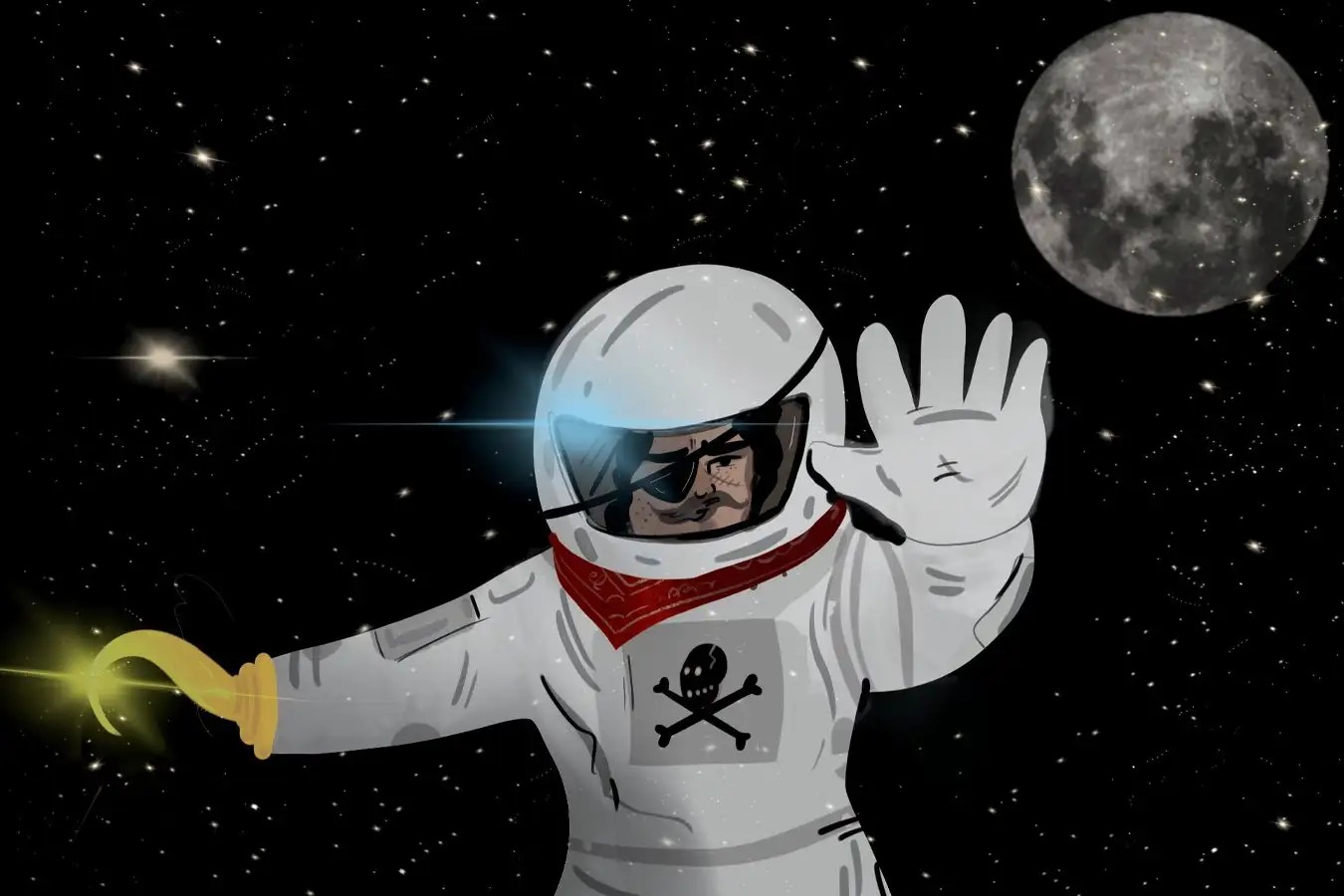
Shiver me timbers?
The moon.
It’s big in the sky. Bigger, apparently, in the heads of people who think they have the future figured out. The hype is deafening. People act like this celestial body is the next great distraction. Maybe it is.
Back in March, PwC tried to forecast a lunar economy. They used billions in their projections. A bold move. The current Gross Lunar Product is roughly $0.00.
Yet here we go again.
The US Space Force isn’t just sitting around. They’re setting up a “cislunar coordination office.” Fancy term. It means they want to figure out how to fight wars near the moon. Imagine the US builds a base there. How do you protect it? How do supply ships get in without getting shot down? You need control. Operational control of the space between Earth and the moon.
We fell down the rabbit hole. Of course we did.
Turns out there’s a 2025 book on the subject: Space Piracy by Marc Feldman and Hughes Taylor. The premise? Criminals will rob us in orbit. Existing gangs. Rogue states. Hack a spacecraft’s software. Blockade the moon to starve out a base.
The authors are serious enough to found a center specifically for studying space crime.
Is this forward thinking or paranoia?
History is full of “impossible” claims. People said planes couldn’t fly. Said computers were novelties. The moon is empty now, sure. Profit? Crime? War? None of it exists yet. Maybe that won’t hold true forever.
We checked in with Mark T. Peters II. He’s a retired US Air Force officer. He reviewed the book. He isn’t buying it.
“Despite some logical arguments, I cannot understanding any scenario with viable space pirates.”
His point stands. Cyber threats? Yeah. Those are real. Everyone knows them. But physical space piracy? Peters says the book fails to prove it’s possible in any other area.
So what is it? Policy planning. Or just guys having fun workshopping a plot for The Expanse? Probably useless. Definitely fun. Sign us up.
The math didn’t work out
Correction time.
We messed up. We admitted something was silly without realizing how silly. It concerns US Health Secretary Robert F. Kennedy Jr.
He was talking drug prices. Said a rise from $100 drug to $600 drug was a “600 percent rise.” Then said if it dropped from $600 back to $100. That’s a “600 percent savings.”
Most people saw the second part as nonsense. A 100 percent drop leaves you with nothing. He implied you lose money. Or gain negative money.
But we missed the first part.
Reader Chris Smart set us straight. Let’s not name-drop people with names that sound like jokes unless they’re actually making a point. Chris pointed out the first statement was also wrong.
$100 to $609 is a $500 increase. That’s 500 percent.
RFK Jr. was wrong about the rise. And wrong about the drop. Double error. As Chris called it: a “vacuous truth.”
The confusion stems from mixing up the percentage increase with the final value’s percentage of the original.
- New value is $600.
- Original value is $100.
- New value is 600% of the original.
- But the rise is 500%.
Tom Brock explained it well. These numbers confuse everyone. Including reporters. Maybe we shouldn’t use percentages. Stick to raw numbers. Less room for error.
Embarrassing? A little.
But neither we nor the Health Secretary have lives on the line. Just pride. 📉
Off the shelf
Our podcast algorithms know us too well now.
Usually it’s fine to have websites guess our interests. This time, the app delivered Off the Shelf. It’s about books and publishing. Right up our alley.
The host has the perfect last name for it.
Morgann Book.
The blurb has to mention that. It says “yes. That is her actual last name.” It’s a bit on the nose. But effective.
Got a tip for us? 📚