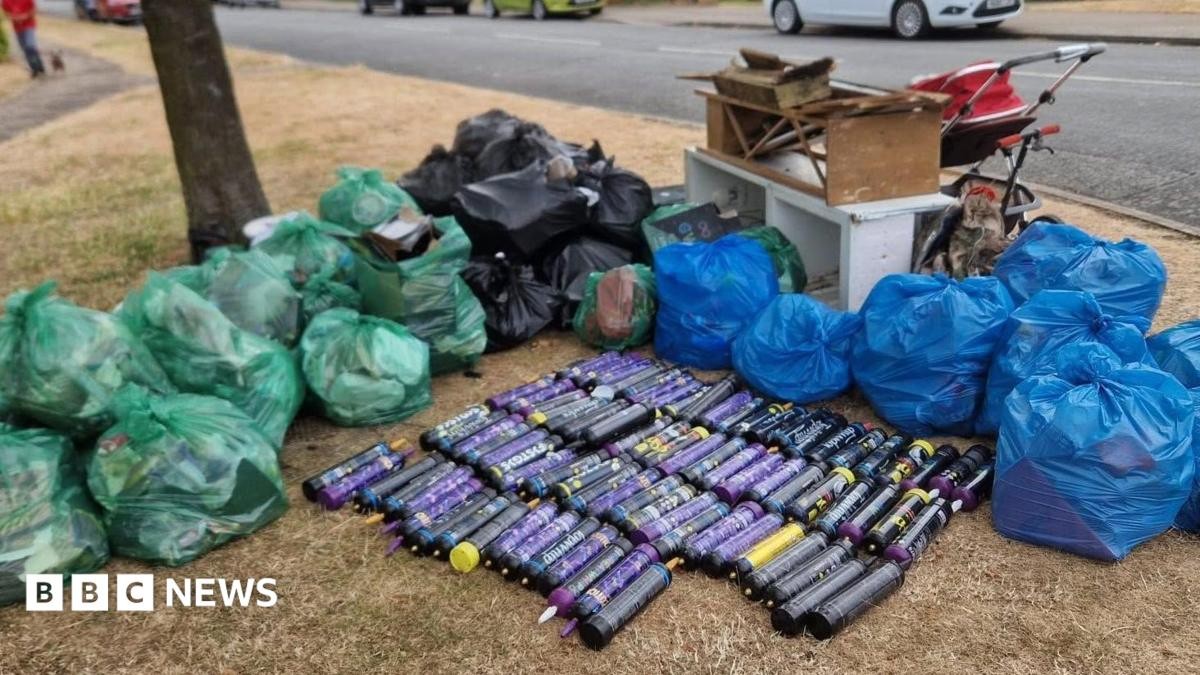
It started with a routine walk around Norman Road Car Park in Peterborough. The volunteers from the Peterborough Litter Wombles expected their usual trash. Then they saw them. Dozens of them. Maybe hundreds of pounds worth of discarded metal.
They counted 82 nitrous oxide canisters in a single day.
Eighty-two.
Harry Machin, a member of the volunteer group, didn’t blink. He just started counting. His team usually picks up between three and twelve canisters during a shift. That is normal. That is the baseline for the city. What they found yesterday was an outlier. An anomaly. It was “off the scale,” as Machin put it.
But numbers alone don’t tell the whole story of this growing problem in Peterborough. The shape of the waste has changed too.
Gone are the days of small, silver balloons and tiny canisters that vanished easily into the grass. The litter on the ground now tells a different tale. Volunteers are consistently finding larger canisters. Heavier. More industrial. It suggests a shift in usage, or perhaps just a shift in who is leaving them behind.
“Some of them are historic, but an awful lot we find are current,” Machin noted.
The “historic” ones imply a backlog. A pile-up of neglect. But the “current” ones? Those are fresh. They are warm to the touch if you hold them long enough. They were used hours, maybe minutes, ago.
This isn’t just about litter. It is about a Class C drug that is being misused in public spaces with alarming disregard. The canisters themselves are often pressurized. They are sharp. They cut. And when they are thrown away on a car park near residential roads, they become hazards.
Cambridgeshire Police have seen this too. They aren’t just watching the litter pickers. They are tracking the waste. Over the last twelve months, the force disposed of 972 nitrous oxide canisters. That is nearly a thousand. A year-long accumulation of empty shells. And like the volunteers, police officers are noting the increase in larger canisters being discarded in and around Peterborough.
Why does it matter where these cans are found?
Because the location is telling. Norman Road Car Park isn’t a secluded forest. It is a transit hub. A place of